Background
At the production volumes required for BMW's Neue Klasse platform — hundreds of millions of cells — a small fraction of cells will inevitably contain manufacturing defects: metallic particles in the jelly roll, electrode micro-cracks, tab burrs folding inward. Most are caught by quality monitoring systems; some are not.
A defective cell may initially perform normally but degrade progressively under cycling, eventually developing an internal short circuit that can escalate to thermal runaway and fire.
The Problem
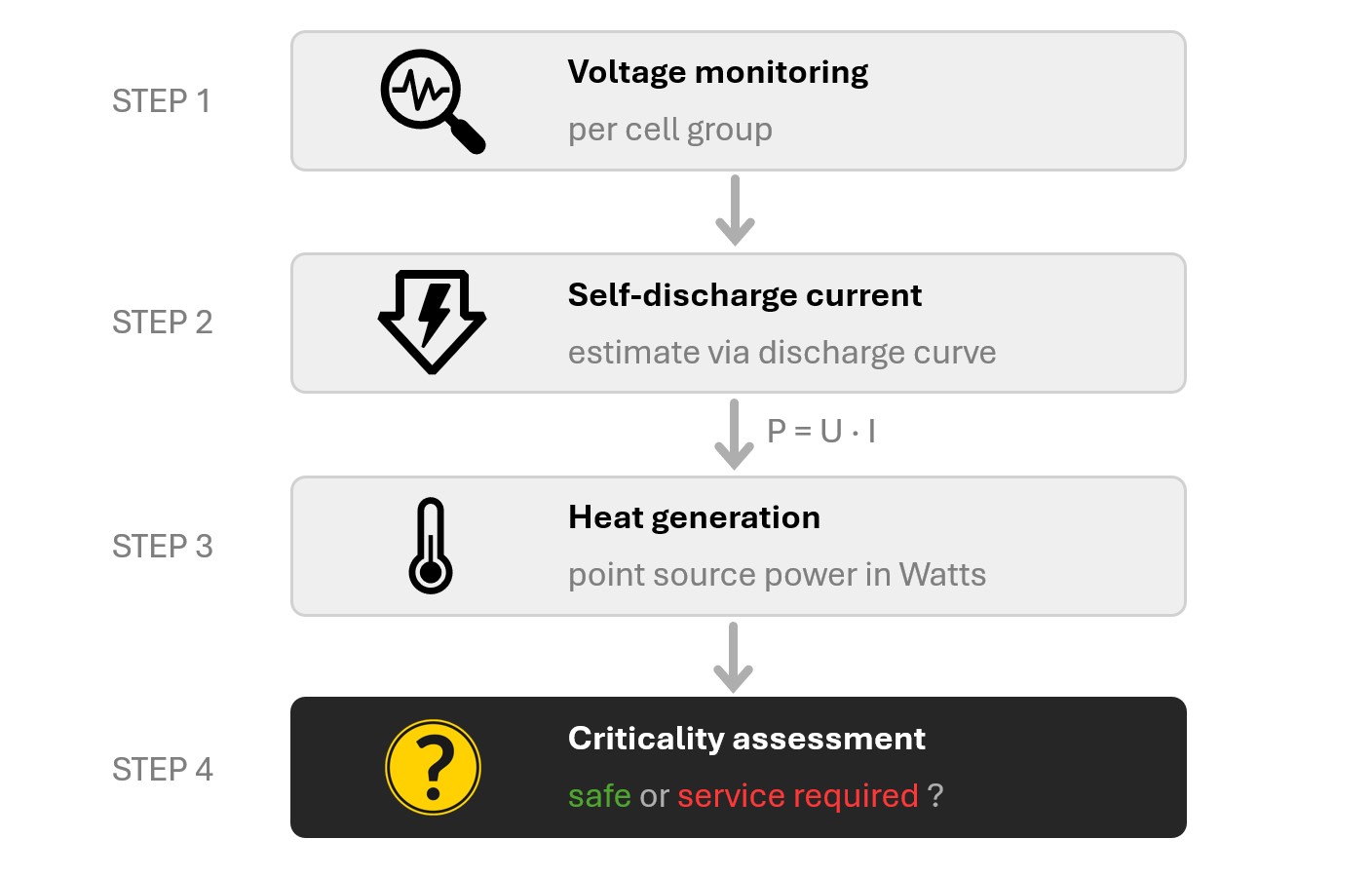
BMW needed a software-only on-board diagnostic system capable of flagging suspicious cells using only sensors already present in production vehicles — specifically, per-parallel-group voltage monitoring (already standard in every BMS).
The core challenge: setting detection thresholds. Too sensitive → excessive false alarms and unnecessary service visits. Too lenient → dangerous defects go undetected. Neither extreme was acceptable.
What was missing was a quantitative understanding of how much heat a manufacturing-induced internal short circuit generates, and how much heat is needed to trigger thermal runaway under real operating conditions.
My Approach
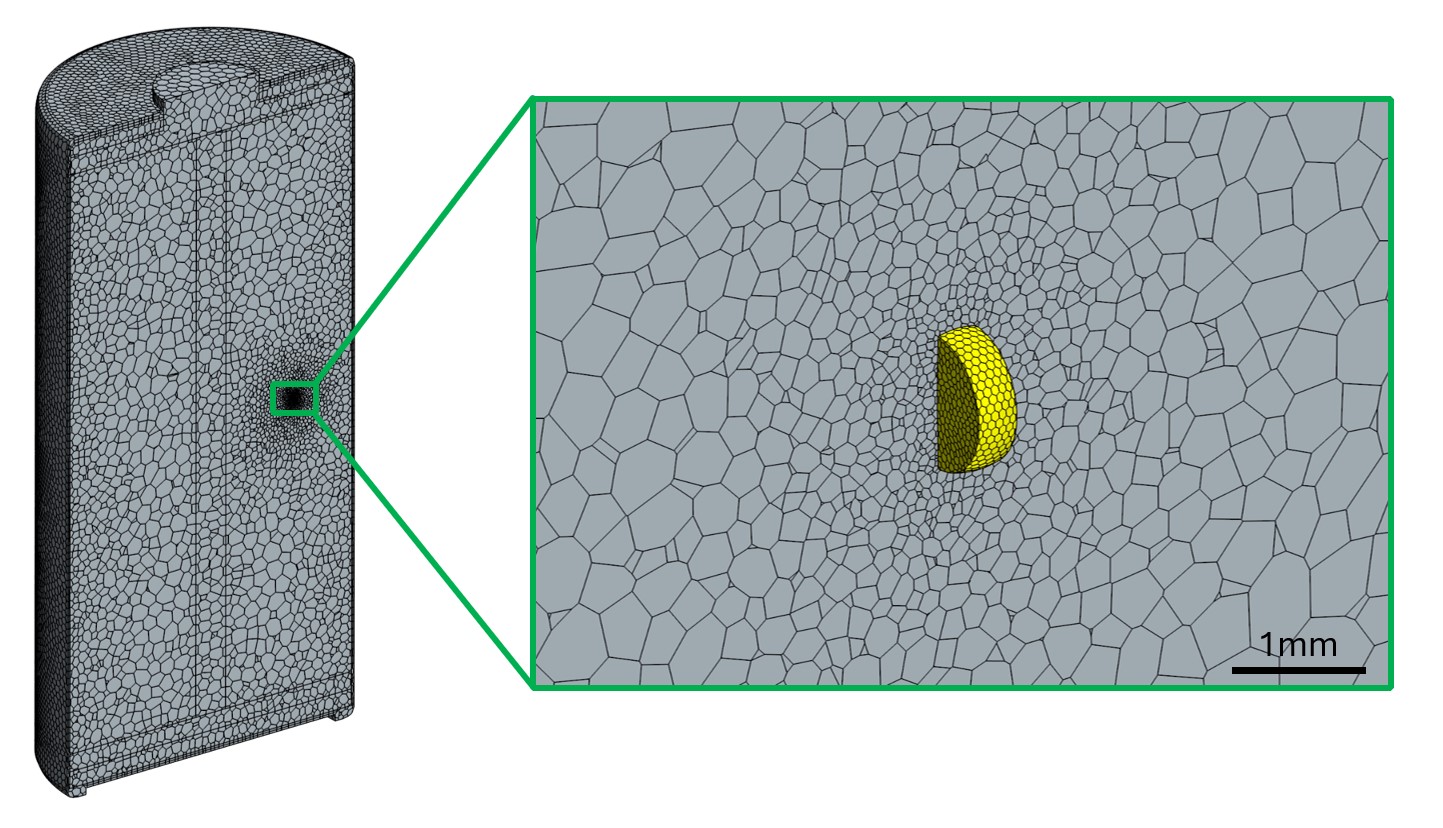
After an intensive literature review of degradation mechanisms — from initial defect through SEI growth, lithium plating, separator failure, to thermal runaway — I developed a 3D thermal simulation in Star-CCM+.
Key model features:
- Cylindrical cell geometry with jelly roll, surrounded by neighbouring cells in a representative pack section
- Configurable point heat source emulating short circuits of varying intensity
- Thermal reactivity of the jelly roll implemented from ARC (Accelerated Rate Calorimetry) measurement data — capturing exothermic reactions triggered at elevated temperatures
- Anisotropic thermal conductivity — distinguishing radial (low, through separator sandwich layers) from axial (high, along electrode conductors) heat transport
- Configurable ambient temperature and heat dissipation boundary conditions
- Surrounding cell and foam thermal properties included
Results
- Critical heat generation threshold determined in Watts — the boundary below which the cell self-cools safely, above which thermal runaway becomes inevitable over time
- Threshold mapped across varying ambient temperatures and state-of-charge conditions
- Results provide direct quantitative input for parametrising the on-board diagnostic algorithm
- Simulation confirmed that voltage-based self-discharge monitoring can in principle detect the relevant defect intensities before they become safety-critical
- Presentation circulated across two BMW departments and repeated for a second audience on request